
Back complaints
(Lower) back complaints can be very troublesome and, like the neck, have a wide range of causes, of which “poor” posture and stress are the most common.
What all these causes have in common is that they are forms of overload. This can take the form of structural overload (stress or poor posture), or acute overload (such as suddenly making an awkward movement, a “thrown-out back”, or acute lumbago).
What often happens is that certain muscles tighten up. This leads to restricted movement and pain. We call this the muscular defence principle: if a vertebra isn't sitting quite right, or a small muscle is strained and causing pain, the entire back and buttock region can react by “locking up”, which maintains or even worsens the complaint. The pain may be felt in the back or buttock region itself, or it may manifest as pain radiating from the back into peripheral body parts such as the buttock, leg, groin, knee, calf or foot. There are several explanatory models, the two most important of which are outlined below.
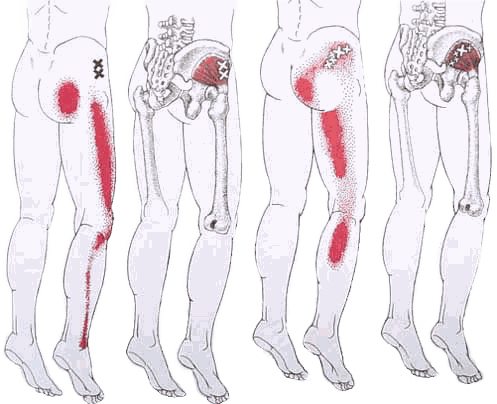
Referred Pain Principle | Myofascial Trigger Points (Dry Needling)
This evidence-based principle explains how, for example, pain in the buttock, groin or knee can arise from muscle tension in the lower back.
A muscle is controlled from the brain via nerve pathways that exit the lumbar spine at a particular level. At that same spinal level, the brain also receives and sends information to and from other muscles and areas of skin. This incoming and outgoing information can interfere with each other, meaning that, for example, a tense muscle in the back → produces pain in the upper leg.
This principle is also where the concept of myofascial trigger points comes from, on which the widely praised and successful Dry Needling method is based. A trigger point is a tender, localised contraction of a small part of the muscle, and feels like a “knot.” Pressure on a trigger point can produce a recognisable pattern of pain radiating to another part of the body. Every muscle has a unique, characteristic referral pattern typical of that particular muscle. These are specific points in the muscle that, anatomically, hold the most tension, and releasing them can allow the entire muscle to relax. Read more about this under DRY NEEDLING.
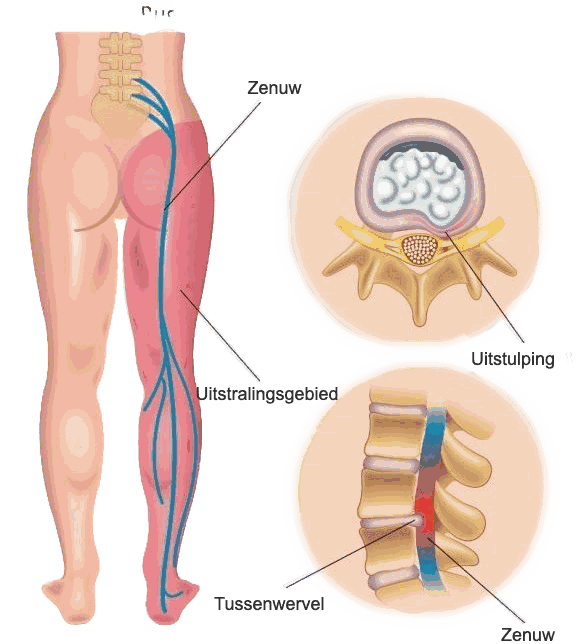
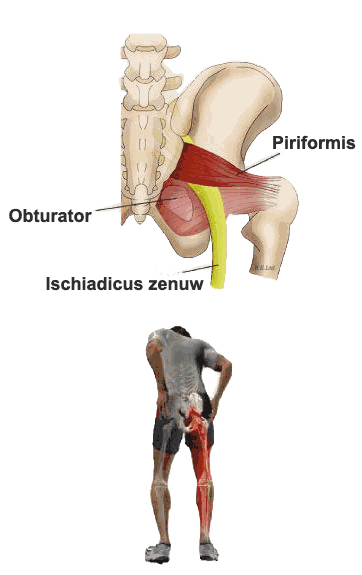
Another explanation attributes radiating pain to nerve entrapment. This entrapment can occur further along the course of the nerve, or have its origin in the back itself (dermatomes), each producing a different pattern of complaints. Entrapment originating in the back can, for example, point to a disc herniation or derangement (see McKenzie). Entrapment along the course of the nerve can be caused by certain muscles being tense and therefore thickened, pressing against a nerve. An example of this is piriformis syndrome, also known as sciatica. Here the piriformis muscle, a small muscle in the buttock, is tense and presses against the sciatic nerve, often resulting in pain down the leg. Depending on the pattern of complaints, the therapist can distinguish between these and trace the cause of the complaint.